IWC
Home - Who we are
What We Believe
Weekly Bulletins
Research-Intro
Basic Vocabulary
News-Canadian+Int'l
Related Publications
Assumptions
CBC and Immigration
Web Links
Video Links
Get Involved
Support IWC
Contact IWC
Report Fraud
Graphs/Visuals

WHO ARE WE? WHY HAVE WE ORGANIZED?


Immigration Watch Canada is an organization of Canadians advocating a major reduction to Canada's current record-high immigration levels and major reform to Canada's immigration policies.

We believe Canada should have some immigration, but that immigration levels should be reduced to about 20% of the current annual 260,000 intake.

Many Canadians feel that an immigration tsunami has struck Canada. However, they feel that our government has so distorted immigration information that most people do not know what is going on. In addition, many Canadians feel that the country has been intimidated into silence by Canada's immigration industry and its supporters.

As a result, no other Canadian public policy issue arouses as much irrationality as does the immigration issue. No other issue gets as muddied by irrelevant arguments as does immigration policy.

WHY IS CANADA BRINGING IN SO MANY PEOPLE?

The basic question that has to be asked about current Canadian immigration policies is this: "Why is Canada bringing in so many people?" (As we have already said, currently, Canada allows entry to around 260,000 immigrants per year. The Former Liberal government had a policy goal of raising Canada's intake to 1% of its population annually. If that 1% policy were adopted, around 330,000+ immigrants would enter Canada every year. The NDP has pressured for a 1%+ goal. This would permit even higher numbers to enter Canada.)

OUR FEDERAL GOVERNMENT HAS NEVER PROVIDED A RATIONAL ANSWER

Canada's federal government has never provided a rational answer to the question of why Canada has been bringing in so many people. At different times, it has claimed that it is bringing in large numbers of people to stimulate Canada's economy, to stop an alleged population decline, or to prevent problems created by an aging population.


OUR GOVERNMENT'S OWN RESEARCH CONTRADICTS WHAT IT IS DOING

However, the federal government's own research has told it that with regards to Canada's economy, immigration consumes 99% of the economic benefits it produces. With regard to population decline, in 1990, when Canada had a population of 26+ million, Health and Welfare Canada's demographic research told the federal government that Canada's population would continue growing until 2026 with half (130,000) the immigration we have today, so population decline should not have been an issue to be looked at in 1990. The same Health and Welfare study concluded that Made-In-Canada alternatives (such as making use of 45+ year old unemployed males and encouraging more females to enter the workforce) are superior to immigration in dealing with a larger number of older people in Canada.

In other words, the federal government's research contradicts what it is doing. (See highlights of the major federally-sponsored studies entitled "Charting Canada's Future" and New Faces In the Crowd" in the "Research" section of this web site.)

THERE IS NO WIDESPREAD WORKER SHORTAGE

Desperate for a justification for high immigration, Canada's immigration industry, federal government, several provincial governments, and media have been using a fourth argument for the past year or so. They have been claiming that Canada has a labour shortage.

However, Statistics Canada says that the country has over 1.1 million officially unemployed. Anyone who is familiar with unemployment statistics knows that many of the country's unemployed are not even counted in this number. Therefore, it is probably safe to say that Canada has well over 1.5 million unemployed. The number that are underemployed is probably much higher.

So we return to the basic question: "Why is Canada bringing in so many people?" In addition to the 260,000 immigrants, Canada allows over 200,000+ temporary foreign workers to work here every year.

Like our federal government, Canada's immigration industry has provided an abundance of hysteria, but no concrete evidence to justify the bringing in of so many people. In fact, recent newspaper reports reveal that Canada's immigration industry is committing a large amount of fraud and that our federal government is not monitoring the temporary worker programme.

The lack of any rational explanation for Canada's regular immigration programme and the sloppiness in administering the temporary worker programme are especially disturbing at a time when around 400,000 workers have just lost their jobs.

It is also disturbing because large numbers of the country's own citizens were already sitting "unused" or "underused" on the labour sidelines.

Why are we hearing politicians and others telling us that recent immigrant professionals are under-employed and need immediate attention when tens of thousands of Canadian-born have been in that situation for years and little has been done for them?

IMMIGRATION HAS TRADITIONALLY BEEN USED FOR THE BENEFIT OF CANADIANS

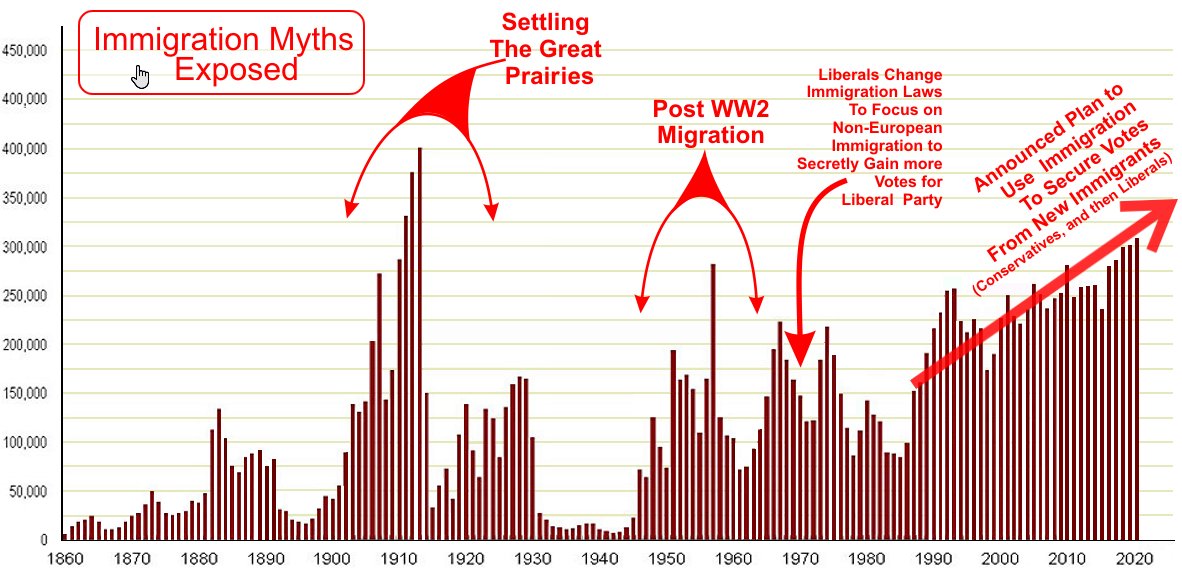
In the past, Canadian immigration policy has given prime consideration to the interests of its own people. particularly its own work force. When unemployment was high, Canada lowered immigration levels. (An example of this policy was the extremely low immigration intake of the 1930's when Canada experienced very high unemployment.) When unemployment was low and Canada needed workers, Canada raised immigration levels. (An example of this policy was the higher intake of the post-WW II era.)

Canada has also had a humanitarian component to satisfy the interests (within the limits of sanity) of immigrant families and genuine refugees. Measures to assist refugees have been based on Canada's signing of the U.N. Convention on Refugees under which we have accepted people fleeing from genuine persecution.

But, in general, Canada's immigration policy has been directed towards the interests of its own citizens. Canada followed this policy for the obvious reason that if the Canadian government did not look after the good of its own citizens, what government would?

THE BIG CHANGE IN 1990

In the late 1980's and early 1990's, Canada entered a completely new phase in its refugee and immigration policies. To say the least, immigration of the past 17 years has been very unlike immigration before that time.

As a result, the interests of Canada's work force (the "Canadian family")have been abandoned. In contrast,the so-called "family class" (that is, the interests of recent immigrants) has been given priority. And the term "refugee" has been expanded far beyond its original limits. The term "refugee" now includes people "fleeing" from such things as spousal abuse, discrimination against gays, parental abuse, ridicule of an obese condition, and a number of other matters which have nothing to do with the original idea of the refugee fleeing political persecution. Moreover, large numbers of refugee claimants actually come from countries with democratic governments and say they are "fleeing" from torture or some other form of persecution.

SINCE 1990, IMMIGRATION HAS BECOME AN UNCONTROLLED, IRRATIONAL FLOOD

Canada's current immigration policy has been described as "mass immigration" because the numbers of immigrants accepted in the past 17 years have been continuously high. In addition, both the numbers of the past 17 years and the numbers projected for the future are unrelated to our economic or demographic needs or absorptive capacity. As many commentators have observed, immigration to Canada has turned into an uncontrolled, irrational flood.

THE CULTURAL ARGUMENT AGAINST HIGH IMMIGRATION

A number of critics have pointed out the potential cultural consequences of Canada's new immigration policies. Among these critics is Ottawa Citizen columnist Randall Denley.

"CELEBRATE DIVERSITY" REALLY MEANS "CELEBRATE YOUR MARGINALIZATION"

He noted in a January, 2003 column, that this policy, if continued, will result in a major cultural change in Canada. The present dominant culture will become a minority and be marginalized by the cultures of those now entering. Mr. Denley asserted that most Canadians are sleepwalking through this massive demographic change in their country.

Others speaking on the cultural issue have said that immigration policy has been reduced to "ethnic catch-up". This means that certain ethnic groups have made deliberate efforts to increase their numbers in order to equal or overtake the numbers of the host population.

THE ECONOMIC AND REFUGEE ISSUES

Former Vice-Chair of Canada's Immigration and Refugee Board, Charles Campbell, discussed a host of immigration and refugee issues in his book, "Betrayal and Deceit". Paying particular attention to economic and refugee issues, he reiterated the findings of the federal government's own research (cited above) which repudiates what it has done for the past 17 years.

CANADA = THE HOLE WAITING TO BE FILLED WITH PEOPLE

Others have noted the environmental impact on Canada. They have said that part of Canada's mythology is that Canada is a virtually unlimited space which can accommodate virtually unlimited numbers of people. However, few of the immigrants to Canada ever set foot in Canada's Northern territories which comprise about 40% of our so-called "limitless land area". Few ever venture into our sub-Arctic areas which border the territories.

In fact, 75% go to the Toronto, Vancouver and Montreal areas which comprise a tiny part of Canada's land base. The very high inflow has put enormous pressure on the ecosystems of these areas. The
2005 annual report by the Environment Commissioner of Ontario, for example, questioned the wisdom of continuing to put very large numbers of people (almost all of whom are immigrants) into Southern Ontario.

Immigration Watch Canada joins Mr. Denley, Mr. Campbell and a host of other well-informed Canadians in expressing alarm at these major changes in Canada's refugee and immigration policies. We express particular alarm at the lack of control the vast majority of Canadians have over Canada's immigration system. We are committed to doing everything we can to make major changes to these policies.

CANADA'S IMMIGRATION INDUSTRY CONTROLS CANADA'S IMMIGRATION NUMBERS

The blunt truth is that a small minority of Canadians is dictating Canada's immigration policies. This group is Canada's immigration industry which consists of immigration lawyers, immigration/refugee advocates and a number of urban MP's. As many observers have noted, these MP's have pandered to the recent immigrant vote to get elected. In effect, these MP's have placed the promotion of their electoral ambitions ahead of the interests of the majority of Canadians.

FIGHT BACK TO GET THE DEMOCRATIC RIGHT TO CONTROL OUR FUTURE

We believe that Canadians have the obvious democratic right to be the major decision-makers in refugee and immigration policies. And it is clear that this right has been taken away from the majority of Canadians. Canada's Department of Citizenship and Immigration, in effect, admits this by excluding ordinary Canadians from its list of so-called "stakeholders", the people whom it consults when it makes immigration policies. This list is confined to Canada's immigration industry.

We also believe that the federal government has to remove the veil of deceit it has placed over its refugee and immigration policies. It has to reveal the consequences of its refugee/immigration strategies.

It is obvious that these strategies are frequently in conflict with the results of the government's own research on the impact of immigration. It is also obvious that they are against the interests of the majority of Canadians and that they make little, if any, sense.

In general, Immigration Watch Canada believes that Canada's immigration policies should place the interests of the majority of Canadians first, not last, as is the situation now.

Canadians have to take back control of their country.

We invite Canadians (both people born here and immigrants) from every side of the political spectrum to join us in restoring sanity to Canada's immigration policies.

(See the section, "What We Believe", the "CBC And Immigration" and "Assumptions" for details.)


matter.

matter.

 Printable Version